

Key Highlights
- This blog explores how small businesses can leverage AI automation to enhance efficiency and productivity.
- Discover the initial steps for implementing AI strategies, including assessing your needs and securing the right tools.
- Follow our step-by-step guide to integrate AI automation into your operations for greater success.
- Learn about different AI tools like chatbots, predictive analytics, and robotic process automation to optimize your business.
- We’ll highlight specific examples from companies like Waking Digital and ServiceNow to show the tangible benefits of AI automation.
Introduction
In today’s fast-changing digital world, using new technologies is a must for success. Artificial intelligence (AI) and machine learning are changing how businesses work, including small businesses. AI automation services provide strong tools to make work easier, improve productivity, and help you stay ahead of the competition. This blog will show you the basics of AI automation and how to use it in your small business.
Understanding AI Automation for Small Businesses

The growth of AI gives a great chance for small businesses to compete better. By using AI to automate routine tasks, owners and their teams can save time. This extra time can help them focus on important plans, building customer relationships, and new ideas.
AI is not just a thing of the future anymore. Businesses of all sizes are now using it. AI automation can be simple, like chatbots that answer customer questions. It can also be advanced, helping with data analysis and decision-making.
Definition and Importance of AI Automation
Artificial intelligence, or AI, means creating computer systems that can do tasks that usually need human thinking. When we say AI automation, we mean using these smart systems to handle business processes. This can be anything from sending customer service emails to handling complex supply chains.
AI automation systems are strong because they can look at large amounts of data. They spot patterns and make decisions faster and better than people. This helps businesses improve their work, become more efficient, and make fewer mistakes.
AI automation is especially important for small businesses. It helps them compete with bigger companies by giving them access to advanced tools and technology that they could not use before.
Key Benefits of AI in Streamlining Operations
One of the best benefits of AI automation is that it makes business processes simpler. It can handle repetitive tasks, like data entry and invoice processing. This gives employees more time for important work. When these tasks are automated, businesses can lower human error, boost accuracy, and speed up their operations.
AI also can improve customer support. AI chatbots can give quick answers to customer questions, suggest personalized options, and fix problems fast. This helps make customers happier and allows human support agents to work on tougher issues.
In addition, AI analytics can look at a lot of customer data to find trends in behavior. This can help improve marketing efforts and give personalized experiences to customers. In the end, this can lead to increased sales.
Preliminary Steps Before Implementing AI Strategies
Before jumping into AI automation, it’s important to look at where you are now and what you will need in the future. This helps you draw up a clear plan for using AI and get the best value from your investment.
Consider the parts of your business where AI can help the most. Are you facing problems like slow workflows, too many customer support requests, or not enough data insights? Finding these issues can help you choose the best AI solutions for your needs.
Assessing Your Business Needs for AI Automation
To successfully use AI automation, you must understand what you need. Start by looking at the parts of your business that take a lot of time or often have mistakes. These areas are good targets for automation. For example, if you spend many hours each week answering the same customer questions, a chatbot might be a great AI solution.
Think about your big plans. Do you want to make customers happier, boost sales, or make things run more smoothly? AI can help with these goals, but you must pick the right tools and methods. For instance, if you want to make the customer experience more personal, AI-driven recommendation engines could work well.
Keep in mind that AI automation doesn’t fit everyone the same way. It’s important to choose tools that match your specific needs to get the most out of them.
Essential Tools and Resources Required
There is a wide range of AI tools and resources available, catering to different business needs and technical expertise. Some popular options include:
| AI Tool/Platform | Description |
| Voiceflow | A no-code platform for building AI-powered chatbots and voice assistants. |
| Zapier | A tool for connecting different apps and automating workflows. |
| Google Cloud AI Platform | A suite of machine learning services for building and deploying AI models. |
Many AI tools require little to no coding experience, making them accessible even for small businesses with limited technical resources. For instance, platforms like Voiceflow allow you to create sophisticated chatbots through a simple drag-and-drop interface. If you’re looking to automate tasks involving natural language processing – such as analyzing customer feedback – several user-friendly NLP tools are available. While some platforms are free to use, others offer paid plans with more advanced features.
Step-by-step Guide to Integrating AI Automation
Now that you understand the basic steps, let’s create a simple guide for adding AI automation to your small business. Remember, this is not a straight path, so adjust these steps to fit your needs and resources.
The important part is to begin small, try new things, and slowly grow your AI projects as you become more confident and skilled.
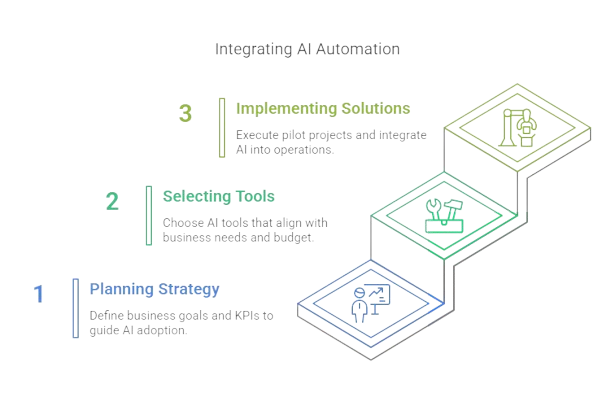
Step 1: Planning Your AI Strategy
The first step is to make sure your AI adoption matches your business goals and plans. Are you trying to improve customer service, boost marketing efforts, or make internal operations smoother? Knowing your goals clearly will help you choose the best AI solutions.
Next, define Key Performance Indicators (KPIs) to check how well your AI projects are doing. This could include customer satisfaction scores, conversion rates, or time saved on certain tasks. Tracking your ROI is important to show the value of your AI investments.
Finally, make sure you have the right data to train your AI models. This could be customer data, sales data, or website analytics. Having clear and relevant data is very important for making accurate predictions and ensuring effective automation.
Step 2: Selecting the Right AI Tools
When choosing from the many AI tools out there, it is important to pick ones that fit your business needs and budget. Think about things like how easy they are to use, if they can grow with your business, how well they work with other tools, and their costs. For example, if you do not have much tech experience, a no-code chatbot platform might be the best choice.
Look for tools that come with templates or pre-built workflows. This can help you get started fast. Many apps focus on particular tasks, like automation for email marketing or managing social media. Keep in mind that the best AI tool for your business depends on what you really need and want to achieve.
Also, check the kind of support and training the AI tool provider offers. Good customer support and clear documentation can be very helpful as you explore the world of AI automation.
Step 3: Implementing AI Solutions
Start by doing a small pilot project in a certain part of your business. This helps you test the waters before fully committing. You can collect feedback, improve your processes, and show your team the benefits of AI solutions. Make sure to easily integrate everything with your current systems. This way, you can avoid problems and improve efficiency.
Taking small steps is important to prevent people from feeling overwhelmed. It also helps your team get used to the new technology. During this time, focusing on clear communication is vital. This way, everyone can understand the advantages and challenges of adopting AI.
Your AI implementation could include:
- AI-powered customer service: Adding a chatbot or virtual assistant on your website to answer questions, provide support, and gather customer feedback.
- Marketing automation: Using AI tools to personalize email campaigns, group your audience, and better manage your marketing budget for improved results.
- Automating repetitive tasks: Using AI to make data entry, invoice processing, or appointment scheduling faster. This will give your team more time for other important work.
Conclusion
In conclusion, using AI automation can help small businesses become more efficient and grow. By looking closely at what they need and using the right tools, these companies can improve how they work, get more done, and stay competitive. Adding AI strategies takes careful planning and work, but it can greatly improve operations and is worth the effort. Small businesses that choose to use AI automation are better able to adjust to changing market needs and find lasting success today. Start your journey with AI transformation now for a more efficient and effective business in the future.